


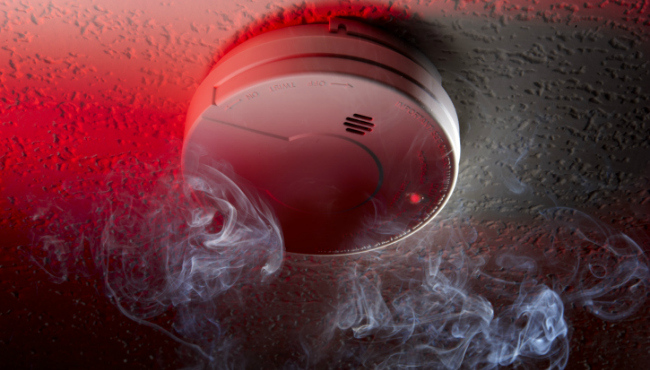
As Michiganders moved their clocks forwared on Sunday, March 12th at 2am, it’s also time to check the smoke and carbon monoxide alarms to ensure homes are protected 24 hours a day, 7 days a week. If alarms have removable batteries, those batteries should be replaced. Alarms equipped with sealed-in batteries should be tested to ensure they are in proper working condition. According to research from the National Fire Protection Association (NFPA), three of every five home fire deaths occur in homes without working smoke alarms, and the vast majority of smoke alarm failures are due to dead or missing batteries. Ten-year smoke alarms require little maintenance, and unlike alarms with removable batteries, they are nearly impossible to deactivate, however they must be tested monthly. “Regardless of the type of alarm in one’s home, it’s also important to clean all alarms to remove debris that might impede their function and to test the batteries, changing them if necessary,” says Firefighter Michael McLeieer from the non-profit fire safety charity E.S.C.A.P.E.
“Installing and maintaining smoke and carbon monoxide alarms on every level of your home is the single most important thing you can do to protect yourself and your family,” says McLeieer. “This simple, but vital maintenance includes ensuring that all alarms are equipped with working batteries. It’s critical these mitigation appliances remain operational to prevent future fatalities during fire, smoke or carbon monoxide conditions,” according to McLeieer.
Here are some smoke and carbon monoxide alarm tips:
* Test all alarms, including 10-year alarms, at least once a month by pressing the test button to be sure they are working.
* If you have an alarm with a removable battery, be sure to change the battery at least annually. If a battery is starting to lose its power, the unit will usually chirp to warn you. Do NOT disable the unit.
* Vacuum or blow out any dust that might have accumulated in the unit.
* NEVER borrow a battery from an alarm to use somewhere else.
* NEVER paint a smoke or carbon monoxide alarm.
* Install at least one smoke alarm on every floor of your home, including the basement, and in or near each sleeping area.
* Alarms should not be installed near a window or heat / air conditioner vents because drafts could interfere with their operation.
* There are two kinds of smoke alarms. Ionization smoke alarms are quicker to warn about flaming fires. Photoelectric alarms are quicker to warn about smoldering fires. It is best to use both types of alarms in the home.
* When a smoke alarm sounds, get outside and stay outside. * Families should also develop and practice a home fire escape plan.
* Replace all alarms in your home every 10 years.
* Always follow the manufacturer’s instructions for installing and testing the alarms and replacing the batteries.
Some fire departments and other organizations offer reduced price or even free smoke alarms and may install battery operated smoke alarms in your home at no cost. Contact your local fire department’s non-emergency phone number or your local American Red Cross chapter, call WOTV’s Operation Save A Life program toll free at 1-844-978-4400 or email [email protected] for more details on a smoke alarm installation program close to Where You Live!

Photo courtesy Jake the Fire Safety Dog
We provide our pets food, attention, medical care, and love. In exchange, they offer companionship, protection, enjoyment, and their own love for us. For all they have to offer, they must rely on us for protection from harm.
Did you know pet poisoning cases dramatically increase around Valentine’s Day? Some well-intentioned gifts actually can be toxic for pets.
The E.S.C.A.P.E. Fire Safety team and Jake the Fire Safety Dog offer some common causes of pet poisoning along with tips to keep your pet safe:
Roses: Although roses don’t often cause serious poisoning beyond gastrointestinal upset, there’s risk for trauma to the mouth and paws from the thorns. Additionally, if a large enough portion of the rose head or stem is ingested, a bowel obstruction may result.
Lilies: A beautiful but deadly alternative to Valentine’s Day roses is a fresh bouquet of Lilies. The toxin can be found in the petals, leaves, pollen, or even the water in the vase. Lilies are extremely toxic to cats and cause acute kidney failure within one or two days of exposure. If not treated, the exposure and ingestion will likely result in death.
Chocolate and cocoa: The classic Valentine’s Day treats can be toxic to pets. Chocolate and cocoa contain theobromine, a chemical similar to caffeine that’s highly toxic to dogs and cats. The darker or more concentrated the chocolate, the more theobromine it contains. Therefore, the most dangerous chocolates are baker’s chocolate, semi-sweet chocolate, and gourmet dark chocolates. Ingestions of small amounts of chocolate may cause mild vomiting and diarrhea. Larger amounts can cause severe agitation, abnormal heart rhythms, tremors, seizures, collapse or eventually death.
Xylitol: Xylitol is a commonly used and naturally occurring sugar substitute. It can be used alone or in combination with aspartame or other sweeteners and is used in many sugar-free chewing gums, and baked goods. Around Valentine’s Day, beware of its use in breath mints, colorful candy presents or sugar-free cake or muffin mixes. Xylitol may cause a life-threatening drop in blood sugar as well as liver damage in dogs. Within 10-15 minutes of ingestion, dogs may develop hypoglycemia, lose coordination and start vomiting. Collapse and seizures may quickly follow. In rare cases, these signs won’t appear until several hours after ingestion.
Other items to avoid feeding to your pet include:
- Alcoholic beverages
- Coffee (grounds, beans, chocolate covered espresso beans)
- Moldy or spoiled foods
- Onions or onion powder
- Fatty foods
- Salt
- Yeast dough
- Macadamia nuts
- Raisins and grapes
If you suspect a poisoning situation involving your pet, contact your local veterinarian, a local emergency veterinary service or the ASPCA National Poison Center at (888) 426-4435 or the Regional Poison Control Center at (800) 222-1222 for poisoning involving people.

The smell of a cake baking in the oven or a tasty soup simmering on the stovetop is difficult for both children and adults to resist. However, each year over 486,000 individuals in the U.S. and Canada are seen in emergency departments, minor emergency clinics or physician’s offices for the treatment of a burn injury due to cooking, hot liquids, grease, food, tap water and steam.
Most scald burns occur in the home and are typically related to everyday activities such as cooking, eating and bathing. They often occur to young children because of a lack of adult supervision and a failure to follow safe practices.
That’s why National Burn Awareness Week, observed the first full week in February, is designed to teach kids how to be responsible for their personal safety and to increase family awareness of potentially harmful situations in homes throughout the community where you live.
“Children under the age of five are 2.4 times as likely as the general population to suffer burn injuries that require emergency medical treatment.” according to Firefighter Michael McLeieer of the non-profit fire safety charity E.S.C.A.P.E. Inc. “Young children cannot understand the potential dangers of things that can burn them. Today, 96.8% of those who suffer burn injuries will survive. Unfortunately, many of those survivors will sustain serious scarring, life-long physical disabilities, and adjustment difficulties,” said McLeieer.
Facts about burn related injuries:
- The primary causes of burn injuries include fire-flame, scalds, electrical and chemicals.
- Hot water scalds are the leading cause of burns to young children.
- Men are more likely to be burned than women (68% males and 32% females were seen at a burn unit).
- Most of the injuries occur in the home (73%) followed by work (8%).
- Tragically, children, the elderly, and the disabled are especially vulnerable to burn injuries, and almost one-third of all burn injuries occur in children under the age of 15.
- Young adults ages 20-29 have a probability of a burn injury that is roughly 1.5 times the risk of the general population.
Prevent burns and scalds in the kitchen:
- Place objects so that they cannot be pulled down or knocked over.
- Turn pot handles away from the stove’s edge.
- Use dry oven mitts or potholders. Hot cookware can heat moisture in a potholder or hot pad, resulting in a scald burn.
- Remove food that has been cooked in the microwave carefully. Open containers slowly and away from the face.
- Wear short, close-fitting or tightly rolled sleeves when cooking.
- Have a “kid-free zone” of at least 3 feet around the stove.
- Never hold a child while you are cooking, drinking a hot liquid, or carrying hot foods or liquids.
General first aid for burns and scalds:
- Treat a burn right away by putting it under cool, running water. Cool the burn for fifteen to twenty minutes.
- Cover a burn with a clean, dry cloth. Do not apply creams, ointments, sprays or other home remedies.
- Remove all clothing, diapers, jewelry and metal from the burned area. These can hide underlying burns and retain heat, which can increase skin damage.
- Seek immediate emergency medical care for more serious burns to prevent infection, other complications and death.
National Burn Awareness Week is the perfect time to share this information, develop a fire escape plan, check your smoke alarms, and make your kitchen and entire home safe for those you care for Where You Live!
* Information provided by the American Burn Association, United States Fire Administration and National Fire Protection Association.

National Burn Awareness Week is February 5 – 11, 2017. Please listen to some important burn prevention tips shared on WKZO AM 590 radio Monday morning February 6th at 9:10 a.m. by our founder Firefighter Michael McLeieer.
Members from the Saugatuck Township Fire District and Graafschap Fire Department spent their Saturday morning (December 17, 2016) installing FREE smoke and carbon monoxide alarms at Johnson Village as part of their Community Risk Reduction program.
If you live in the Saugatuck Township Fire District you can request a free alarm evaluation and installation through the web site at www.SaugatuckFire.org or by calling 269-857-3000.
Both the Saugatuck Township Fire District and Graafschap Fire Department are part of the WOTV Operation Save A Life program serving 14 counties throughout West Michigan. If you live outside of the STFD or GFD areas and are in need of a new smoke or carbon monoxide alarm, please call toll free 1-844-978-4400 or email [email protected].