



White Pigeon firefighters (left) and Michigan State Firemen’s Association Executive Board (red jackets)
LAPEER, Mich. – Saturday May 19th, four members from the White Pigeon Fire Department in St. Joseph County were presented the 2018 Heroes Award by the Michigan State Firemen’s Association at the 143rd Annual Conference dinner and banquet in Lapeer.
Fire Chief Troy Andrews (with 19 years of service), Lieutenant Jeff Wagaman (with 14 years of service), Firefighter Thomas Law (with 14 years of service), and Fire Cadet Merlin Zehr (with 1 year of service) were recognized for their heroic efforts from a rescue which occurred on January 27, 2018, when a 54-year old man fell through thin ice while fishing. Upon arrival, White Pigeon firefighters noticed the fisherman was in frigid water holding on to the edge of the ice shelf.
White Pigeon firefighters worked together as a team following the Incident Command System and utilizing their frequent training to execute this rescue. Chief Andrews donned the department’s ice and cold water rescue suit, climbed into the water and rescued the hypothermic fisherman.
“These men have it in their heart to serve their community,” said Assistant Chief Tyler Royce, who nominated his brother firefighters for the Heroes Award. “They dedicate countless hours of their own time preparing our department to respond to and mitigate the next emergency,” said Royce.
White Pigeon Fire is a WOTV 4 Women Operation Save A Life department. Firefighters provide free smoke alarms and community risk reduction messaging to residents in need.
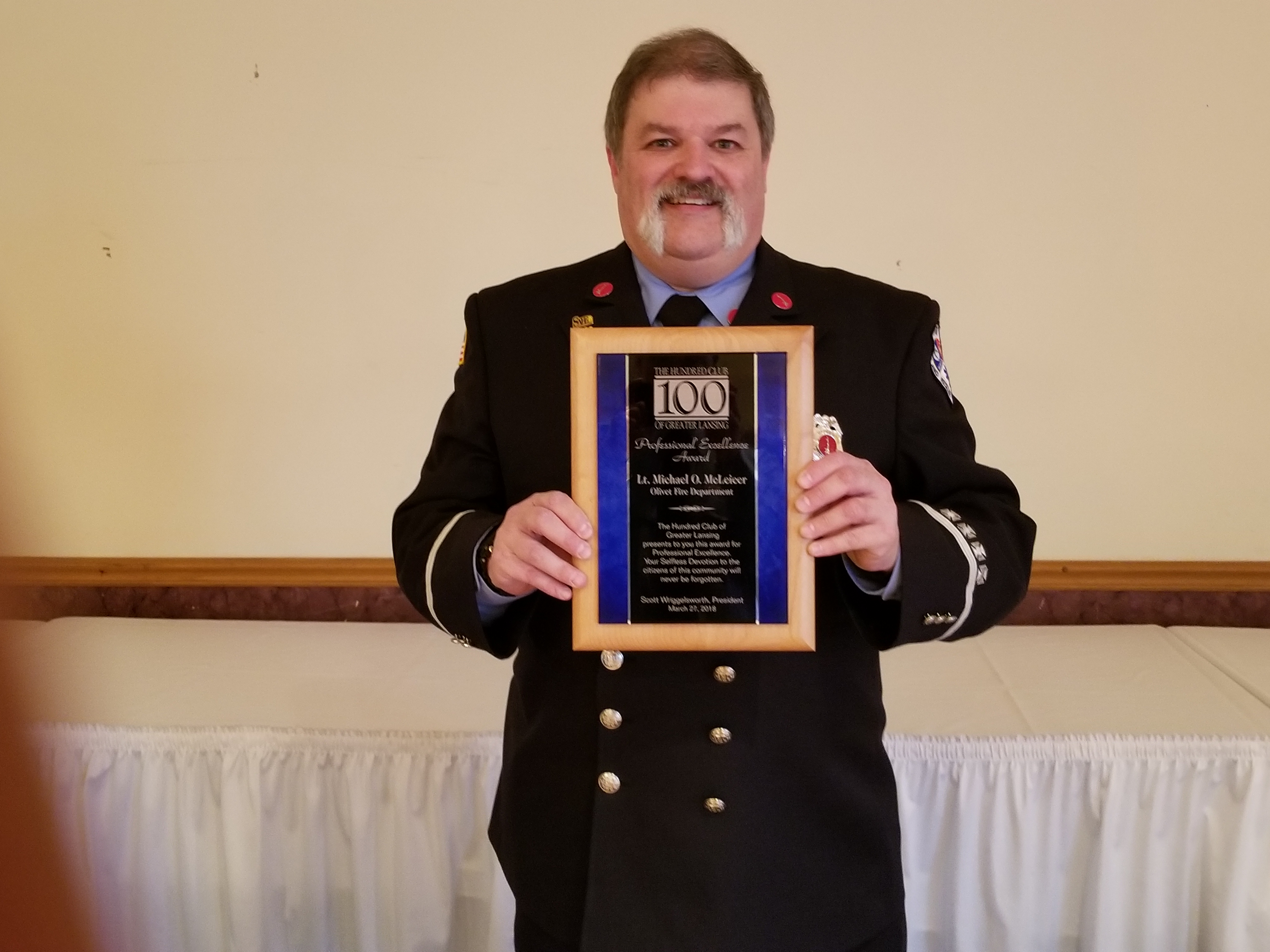
On March 27th, 2018 Lt. Michael McLeieer from the Olivet Fire Department in Eaton County, President and Founder of the non-profit public charity E.S.C.A.P.E. Inc. and the only member from the fire service, received the 2018 Professional Excellence Award from The 100 Club of Greater Lansing at their annual meeting held at the Royal Scot banquet facility in Lansing.

This award is in recognition of leading a team of public safety professionals and other community advocates who collectively identify leading risks causing home fires, reducing fire fatalites and eliminating risky behavor which often results in injury or death. Over the past 4 years, West Michigan has seen a 62% reduction in home fire deaths across a 14-county region thanks to the great work by our firefighters, police officers, American Red Cross Disaster Responders, businesses and other community advocates.

McLeieer is the 1st Vice President of the Michigan State Firemen’s Association and is the Fire and Life Safety Program Coordinator for WOTV 4 Women and WLNS 6 News Safety For You providing free smoke alarms, carbon monoxide alarms and fire safety information to West Michigan fire departments in order to educate families on ways to stay safe.

Firefighter Michael McLeieer, President and Founder of E.S.C.A.P.E. Inc. spoke with Ken Lanphear this morning on WKZO AM 590 and FM 106.9 about outdoor burning risks.
Each year wildfire burns millions of acres of land throughout the United States. Here are some safety tips when conducting outdoor burning:
- Create a safety zone of up to 100 feet around your home.
- Remove pine needles and dry leaves from around your home.
- Keep woodpiles at least 30 feet from your home.
- Before conducting open burning, check with your local fire department to determine if a burn permit is required in your community.
- People conducting illegal burning, or who allow a fire to get out of control, may be held liable for the costs of extinguishing the fire in addition to fines or imprisonment.
- Weather and air quality can change rapidly, especially in the spring when humidity levels are low. Avoid burning during high wind and extremely dry conditions.
- Be prepared to extinguish the fire if the wind picks up or the weather changes. Use common sense.
- Have fire control tools handy – this includes a water supply, fire extinguisher, shovels and rakes.
- Avoid burning tires and trash.
- A responsible adult should always be present during outdoor open burning until the fire is extinguished.
- Children and pets should be kept a safe distance away.
- Use paper and kindling to start the fire and add progressively larger pieces of wood.
- Never use gasoline, kerosene and any other flammable liquid to start a fire because the risk of personal injury is high.
- Burn one small pile of material at a time and slowly add to it. This helps keep the fire from getting out of control.
- Select a burn location away from any utility lines and buildings.
- If a fire gets out of control, call 911 immediately to request the fire department.
The Morning Show with Ken Lanphear talks with Firefighter Michael McLeieer of E.S.C.A.P.E. and the Michigan State Firemen’s Association about a new statewide campaign that will prevent home fires, connect families with resources and keep Michiganders S.A.F.E.! If you have questions about smoke alarms, carbon monoxide alarms or fire safety, please call 1-844-978-4400 or email [email protected]!

When was the last time you checked your smoke alarm? Since January 1st, Michigan has experienced 25 fire fatalities and remains a leading state for home fire deaths. These deaths have occurred in homes that did not have working smoke alarms. E.S.C.A.P.E. Fire Safety reminds you that properly installed and maintained smoke alarms on every level of your home are the only mitigation devices that can alert you and your family to a fire 24 hours a day, seven days a week. Whether you’re awake or asleep, a working smoke alarm is constantly on alert, scanning the air for fire and smoke.
Take the opportunity when you move the clocks forward one hour at 2 a.m. on Sunday March 11th, to make sure you test your smoke and carbon monoxide alarms and replace the batteries as needed. Also replace alarms that are over 10 years old.
According to the National Fire Protection Association, almost two-thirds of home fire deaths resulted from fires in properties without working smoke alarms. A working smoke alarm significantly increases your chances of surviving a deadly home fire.
There are many different brands of smoke alarms available on the market, but they fall under two basic types: ionization and photoelectric.
It cannot be stated definitively that one is better than the other in every fire situation that could arise in a residence. Because both ionization and photoelectric smoke alarms are better at detecting distinctly different, yet potentially fatal fires, and because no one can predict what type of fire might start in a home, the United States Fire Administration recommends that every residence and place where people sleep be equipped with:
- Both ionization AND photoelectric smoke alarms, OR
- dual sensor smoke alarms, which contain both ionization and photoelectric smoke sensors
In addition to the basic types of alarms, there are alarms made to meet the needs of people with hearing disabilities. These alarms may use strobe lights that flash and/or vibrate to assist in alerting those who are unable to hear standard smoke alarms when they sound.
Smoke alarms are powered by a battery or they are hardwired into the home’s electrical system. If the smoke alarm is powered by battery, it runs on either a disposable 9-volt battery or a non-replaceable 10-year lithium (“long-life”) battery. A backup battery is usually present on hardwired alarms and may need to be replaced.
These batteries must be tested on a regular basis and, in most cases, should be replaced at least once each year (except for lithium batteries).
Install smoke alarms on every level of your home, including the basement. Many fatal fires begin late at night or early in the morning, so the U.S. Fire Administration recommends installing smoke alarms both inside and outside of sleeping areas.
Since smoke and many deadly gases rise, installing your smoke alarms at the proper level will provide you with the earliest warning possible. Always follow the manufacturer’s installation instructions.
Smoke alarms are not expensive and are worth the lives they can help save. Ionization and photoelectric smoke alarms cost between $6 and $20. Dual sensor smoke alarms cost between $24 and $40.
Some fire departments offer reduced price, or even free, smoke alarms and may install battery operated smoke alarms in your home at no cost. Contact your local fire department’s non-emergency phone number for more information or e-mail [email protected] for more details on a smoke alarm installation program close to Where You Live!