


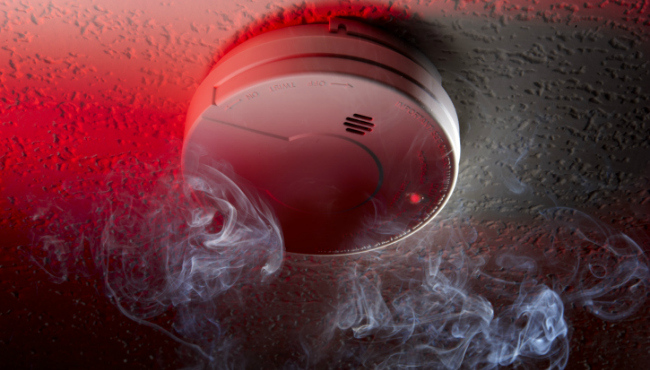
 Did you know that many people don’t test their smoke alarms as often as they should? Smoke alarms are a key part of a home fire escape plan. When there is a fire, smoke spreads fast. You need working smoke alarms to give you early warning so you can get outside quickly.
Facts About Home Fires
Did you know that many people don’t test their smoke alarms as often as they should? Smoke alarms are a key part of a home fire escape plan. When there is a fire, smoke spreads fast. You need working smoke alarms to give you early warning so you can get outside quickly.
Facts About Home Fires
- According to the National Fire Protection Association, in 2011, U.S. fire departments responded to 370,000 home structure fires. These fires caused 13,910 civilian injuries, 2,520 civilian deaths, and $6.9 billion in direct damage.
- On average, seven people died in U.S. home fires per day from 2007 to 2011.
- Cooking is the leading cause of home fires and home fire injuries, followed by heating equipment.
- Smoking is the leading cause of civilian home fire deaths.
- Most fatal fires kill one or two people. In 2012, eight home fires killed five or more people resulting in a total of 44 deaths.
- Almost three of five (60%) of reported home fire deaths throughout the U.S. from 2007 to 2011 resulted from fires in homes with no smoke alarms or no working smoke alarms.
- Working smoke alarms cut the risk of dying in reported home fires in half.
- In fires considered large enough to activate the smoke alarm, hardwired alarms operated 93% of the time, while battery powered alarms operated only 79% of the time.
- When smoke alarms fail to operate, it is usually because batteries are missing, disconnected, or dead.
- An ionization smoke alarm is generally more responsive to flaming fires and a photoelectric smoke alarm is generally more responsive to smoldering fires. For the best protection, or where extra time is needed, to awaken or assist others, both types of alarms, or combination ionization and photoelectric alarms are recommended.
- Install smoke alarms inside and outside each bedroom and sleeping area. Install alarms on every level of the home, including in the basement.
- Large homes may need extra smoke alarms.
- It is best to use interconnected smoke alarms. When one smoke alarm sounds, they all sound.
- Test all smoke alarms at least once a month. Press the test button to be sure the alarm is working.
- A smoke alarm should be on the ceiling or high on a wall. Keep smoke alarms away from the kitchen to reduce false alarms. They should be at least ten feet from the stove.
- People who are hard-of-hearing or deaf can use special alarms. These alarms have strobe lights and bed shakers.
- Replace all smoke alarms when they are ten years old.
October is National Fire Prevention Month. This year’s theme is “Working Smoke Alarms Save Lives – Test Yours Every Month!”. From Fire Department Open Houses to events with a focus on fire prevention education, there are numerous opportunities for children and families to attend one of the following events and learn about fire safety and injury prevention close to Where You Live.
(Please note: event dates and times may be subject to change. Please check with your local fire department for more details)
Allegan County
Dorr Township Fire Department
4th Annual Dorr Twp. Fire Dept. Pancake Breakfast and Open House
4196 18th Street
Dorr, MI 49323
Saturday October 11, 2014
7 – 11 a.m.
- Serving: Pancakes, eggs, sausage, hash browns, beverages.
- Donations accepted with some of the proceeds going to start a scholarship program for High School Seniors entering Fire Science or EMS.
- Games and prizes, along with face painting for kids
- Also there will be a silent auction
Otsego Fire Department
Home Depot Safety Day
1227 M-89
Plainwell, MI 49080
Saturday October 11, 2014
9 a.m. – 1 p.m.
Plainwell Department of Public Safety
Fire Prevention Week Open House
Public Safety Building
119 Island Avenue
Plainwell, MI 49080
Saturday October 4, 2014
10 a.m. – 3 p.m.
- Building Tours
- Fire Prevention Information
- Jr. Firefighter Combat Challenge
- Allegan County Smoke House for Kids
- Smoke Alarm Information
- Red Cross Van with Safety Information
- Hot Dogs from 11 a.m. – 1:30 p.m.
Wayland Fire Department
Fire Prevention Week Open House
160 West Superior Street
Wayland, MI 49348
Wednesday October 8, 2014
6 – 8 p.m.
Any questions feel free to call (269) 792-6300
- Free refreshments and cookies will be provided
Kalamazoo County
11th Annual Family Fire Safety Day
Lowe’s of Portage
Portage Department of Public Safety – Fire Division
E.S.C.A.P.E. Fire Safety / WOOD TV 8 – WOTV 4
5108 South Westnedge Avenue
Portage, MI 49002
Saturday October 25, 2014
10 a.m. – 2 p.m.
Meet WOOD TV8’s Bill Steffen and Jake the Fire Safety Dog. Free nine volt batteries and smoke alarms will be available (while supplies last). The E.S.C.A.P.E. Smoke Demonstration trailer will teach families how to be safe from fire. Free fire extinguisher demonstration. Tour the Portage Public Safety Fire Engine, Life EMS Ambulance and learn about smoke alarms from Safe Kids of Kalamazoo County. Free games and prizes for those who know the correct answers to the safety questions presented throughout the day. Halloween costume contest begins at 11 a.m. with prizes.
Comstock Township Fire & Rescue
Fire Department Open House
Central Station #1
1960 River Street
Kalamazoo, MI 49048
Saturday October 11, 2014
11 a.m. – 2 p.m.
- Meet the firefighters, learn about a fire truck, auto extrication demonstration will begin at 1 p.m., use a thermal imaging camera, visit with Sparky™ and Friends, enjoy refreshments and win door prizes.
Portage Department of Public Safety – Fire Division
Fire Prevention Week Open House
Station #1 – 7800 Shaver Road
Portage, MI 49024
Saturday October 11, 2014
10 a.m. – 2 p.m.
Richland Township Fire Department
Fire Prevention Week Open House
7401 North 32nd Street
Richland, MI 49083
Saturday October 11, 2014
9 a.m. – 3 p.m.
Kent County
Grandville Fire Department
Annual Open House
3215 Wilson Avenue
Grandville, MI 49418
Tuesday October 7, 2014
6 – 8 p.m.
For more information, please contact the fire station at (616) 530-6211
- Learn fire safety, see a police car, fire truck and an ambulance!
- Enjoy cookies, popcorn, and drinks!
- Meet Sparky™ The Fire Dog, Firefighters, Police Officers, and Paramedics!
- Learn CPR! Save a Life!
John Ball Zoo Goes Boo
E.S.C.A.P.E. Fire Safety / Grand Rapids Fire Department
1300 West Fulton
Grand Rapids, MI 49501
Friday October 17, 2014
10 a.m. – 3 p.m.
Walker Fire Department
Fire Prevention Open House
4101 Lake Michigan Drive NW
Walker, MI 49534
Monday October 6, 2014
6 – 8 p.m.
- Activities will include tours of the fire station and apparatus. Home fire safety information and packets will be distributed to attendees. There will be free smoke alarms available for those who visit with an emphasis on Walker firefighters installing them for Walker residents.
Muskegon County
Dalton Township Fire Department
1650 E. Riley Thompson
Muskegon, MI49445
For more information, call (231) 766-3277
Wednesday October 8, 2014
6 – 8 p.m.
Muskegon Fire Department
Fire Prevention Week Open House
Central Station – 770 Terrace Street (next to Hot Rod Harley)
Muskegon, MI 49440
Sunday September 28, 2014
2 – 4 p.m.
The Muskegon Fire Department would like to cordially invite you and your family to our annual Fire Prevention Open House. Anticipated activities include:
- Jaws of Life demonstrations
- Tours of Central Station
- Displays of all Fire Department apparatus
- Working hose lines for the kids
- The Fire Prevention Theatre
- Hazardous Materials Team will be showing off their equipment
- Free Food and Refreshments
- Fun for kids of all ages!
- A glimpse into the daily life of a Firefighter in Muskegon
Ottawa County
Georgetown Township Fire Department
Fire Prevention Open House
Fire Station #1
Corner of 14th Avenue & 44th Street
Georgetown Charter Township
Thursday October 2, 2014
6 – 8 p.m.
The 12th Annual New Jersey Juvenile Firesetter Intervention Conference will be held at the Middlesex County Fire Academy December 4 – 5, 2014.
This year’s theme is: “Social Media: Spreading Information at the Speed of Fire.
For Fire Service, Mental Health, Law Enforcement, Social Service, and Educational Professionals
Please select the following link for the Conference Flyer which includes a list of the speakers and their presentations as well as the pre-registration requirements and payment of $100:
To register, please select the following link:
http://www.keanfiresafety.com/conferences-2/juvenile-firesetter-registration-form-2014/
Read More
Be Disaster Aware, Take Action To Prepare
Emergencies can happen at any time. Does your family know how to get in touch with each other if you are not all together?

Before an emergency happens, have a family discussion to determine who would be your out-of-state point of contact, and where you would meet away from your home – both in the neighborhood and within your town.
Let them know you are OK
Pick the same person for each family member to contact. It might be easier to reach someone who’s out of town.
Text, don’t talk!
Unless you are in danger, send a text. Text messages may have an easier time getting through than phone calls, and you don’t want to tie up phone lines needed by emergency workers.
For more information and to download and complete a Family Communication Plan, visit http://www.fema.gov/media-library-data/0e3ef555f66e22ab832e284f826c2e9e/FEMA_plan_parent_508_071513.pdf

September is National Preparedness Month
More than 3,400 Americans die each year across the country in fires and approximately 17,500 are injured. An overwhelming number of these fires occur in the home. There are time-tested ways to prevent and survive a fire. It’s not a question of luck. It’s a matter of planning ahead.
In the event of a home fire, every second counts. September is National Preparedness Month and the United States Fire Administration and E.S.C.A.P.E. Fire & Safety offer these tips to keep you and your family safe.

Have Two Ways Out
- Plan and practice home fire drills as a family.
- Draw a map of each level of your home showing all doors and windows.
- Discuss the map with everyone who lives with you.
- Practice your home fire drills at least twice a year.
- Make sure all doors and windows that lead outside open easily.
- Push the smoke alarm button to start the fire drill.
- Try feeling your way in the dark or with your eyes closed.
- Have at least two ways out of every room. If your first way out is blocked by fire or smoke, you can use your second way out.
- If there is smoke, get low and go. Crawl quickly under the smoke to your nearest exit.
- Close doors behind you and gather at a preplanned outside meeting place where firefighters and first responders can see you.
- Remember to Get Out and Stay Out.
- Never go back inside for people, pets or things.
Finally, keep your escape plan posted on the refrigerator so everyone in your home, including guests, know what to do and where to go during fire or smoke conditions. Taking a few minutes now to be prepared might mean the difference between life or death for you and your family Where You Live!
It was a beautiful day to Walk the Zoo at the John Ball Zoo in Grand Rapids Michigan with Maranda, Priority Health and Jake The Fire Safety Dog. Over 100 children and families had a fantastic day of fun while learning how be active and stay healthy.


Another highlight of the morning was presenting Maranda with a letter of appreciation from the United States Fire Administration. She was congratulated on the 20th anniversary of providing families with free fun at Park Parties and for launching and promoting the Fire Is Everyone’s Fight (tm) national fire safety campaign over the past two years here in West Michigan.

Each year in this country, fires set by children are responsible for more than 100 fire deaths, nearly 1,000 painful burn injuries, and hundreds of millions of dollars in property loss, according to the United States Fire Administration. Between 2007 and 2011, an average of 49,300 fires involved children misusing fire occurred throughout the United States. Children are often the victims in these fires. While curiosity about fire is natural, fires set by children are dangerous and deadly.
The danger of fire is greater than ever because of the high number of petroleum-based building materials. Fires burn quicker and hotter and smoke is more toxic than in the past because of these materials. In the hands of juveniles, fire can be deadly. Whether the child or adolescent was playing, experimenting or purposely setting fires, firesetting is extremely costly.
The misuse of fire has many variables including age, motivation for firesetting behavior, type of fires set, ignition materials used to set the fire, and the child’s understanding and limitations of fire. Firesetting behavior is usually “a cry for help” and may be a symptom of a problem manifested through stress and crisis in their lives. The stress or crisis experienced by juveniles may include abuse, bullying, a recent separation or divorce of parents, home foreclosure, moving to a new community, or the death of a pet or loved one.

Why Do Kids Set Fires?
Youth firesetting or the misuse of fire by children isn’t necessarily arson. The best way to understand why children set fires is to look at their motivations for firesetting. For most young kids, the motive is experimentation and curiosity. Motives can involve curiosity, thrill-seeking, willful intent to cause destruction, or by children who suffer from mental or emotional problems.
There are four common factors that influence firesetting behavior among children and adolescents. These factors impact all types of firesetting and include:
- Easy access to ignition materials. Easy access to ignition materials often proves deadly for children who start fires. In many homes where a child has been involved in starting a fire, the child easily discovered the ignition source or already knew where it was located and how to obtain it.
- Lack of adequate supervision. The lack of adequate supervision is a factor that can influence all ages of firesetting among children and adolescents. Parents are often shocked to discover their child has engaged in firesetting over a prolonged period of time.
- A failure to practice fire safety. A failure to practice fire safety is a factor that often affects children and their parents in the following ways:
- Young children often lack understanding of the dangers associated with firesetting and safety rules about fire.
- Older children and adolescents may not have received school-based fire safety education about the dangers of the inappropriate use of fire, penalties for such behavior, and direction on what to do if a fire occurs.
- Parents or caregivers may not be aware of the significance of youth firesetting, appropriate fire safety education, penalties, or what actions to take in the event a fire occurs. They may not be aware of local youth firesetting prevention and intervention programs.
- Easy access to information on the Internet. Information regarding firesetting, designing explosives, and how to do tricks with fire is a problem that demands attention. Technology has made explicit media available to youths on many dangerous and often illegal activities. They are able to experiment with fire or incendiary materials and instantaneously post results for the world to see and oftentimes replicate.
Parents, caregivers, and public educators, whether they are from the fire department or the school system, can build an informed foundation by teaching fire safety at an early age. Teach children of all ages that fires, even small ones, can spread quickly.

Myths and Facts Concerning Children and Fire
Myth: A child can control a small fire
Fact: Most fires start small, but can become uncontrollable quickly.
Myth: It is normal for children to play with fire.
Fact: It is not normal for children to play with fire. Curiosity about fire is normal. Use of fire without an adult’s knowledge, approval, or supervision is dangerous.
Myth: Firesetting is a phase children will outgrow.
Fact: Firesetting is not a phase. If a child is not taught fire safety, the firesetting can get out of control easily. It is a dangerous behavior.
Myth: If you burn a child’s hand, he/she will stop setting fires.
Fact: Purposely burning a child’s hand is child abuse and is against the law. The reason behind the firesetting must be discovered and addressed.
Myth: If you take a child to the burn unit to see burn survivors, he/she will stop misusing fire.
Fact: Going to the burn unit only instills fear, and does not teach a child anything about fire safety. More importantly, we need to be sensitive toward burn survivors who are trying to recover emotionally and physically from their burns.
It is important to understand myths concerning children and fire. Children need to be educated about fire and have their motives understood so that proper interventions can be used to stop the firesetting behavior.
Teaching Children Fire Safety
The most critical message for children to learn is that lighters and matches are tools, not toys! Parents and caregivers should never use lighters, matches, and fire for fun; children will mimic you, and when they do it unsupervised, tragic events can result. Praise your child for practicing responsible behavior and showing respect for fire. Set a good example for safe use of fire.
- Always supervise young children.
- Never leave lighters or matches within reach of children. Keep lighters and matches out of reach in high, locked cabinets.
- Use child-resistant lighters, but remember that they are not child proof.
- Instruct young children to inform an adult if they find lighters or matches.
E.S.C.A.P.E. Fire & Safety reminds you if you suspect your child is setting fires, you are not the only parent ever to face this problem. Contact your local fire department immediately or visit www.kidsandfire.org for a list of youth fire prevention programs in the greater Grand Rapids and Kalamazoo areas.

As summer draws to a close, it’s time to head back to school, meet new friends and say hello to fall. Just like teachers, books, and homework go together with the new school year, safety education should be a priority for every family.
The National Fire Protection Association and E.S.C.A.P.E. Fire & Safety offer these tips to play it safe!
 Bus Safety
While waiting for the bus, take five giant steps back from the curb until the bus has stopped completely.
- Inside the bus, stay seated at all times.
- Keep your arms, hands and head inside the bus.
- Never throw anything about of the bus window.
- Always hold on the bus handrails when you are getting on or off the bus so you don’t fall.
- Be careful that clothing, book bags, and key rings don’t get caught in the handrails or doors.
- When exiting the bus, go to the closest sidewalk or side of the road and take five giant steps away from the bus.
- If you drop something near the bus, tell the bus driver. If you bend over to pick it up, the bus driver may not be able to see you.
 Safely Walking to School
Children under age 10 should never cross a street without a grown-up.
- Choose a safe route to school. Look for the most direct route with the fewest street crossings.
- When crossing the street, stop at the curb or edge of the road.
- Look left, then right, then left again for moving cars before crossing.
- Keep looking left and right until you are safely across the street – and remember to walk, not run.
- Follow all traffic signals and markings.
- Don’t enter the street from between parked cars or from behind bushes or shrubs. Drivers might not be able to see you.
- Never wear head phones or talk on a cell phone when crossing the street.
 Bicycle Safety
If you are old enough to ride alone, plan a safe route to school and have a grown-up ride with you the first few times.
- Children under 10 shouldn’t ride on the road without a grown-up.
- Be sure that your helmet fits. It should sit even on top of the head – not rocking in any direction – and always fasten the safety strap.
- Learn the proper hand signals and use them when you turn or stop.
- Walk, do not ride your bike across the street.
- Come to a complete stop before entering driveways, paths, or sidewalks, then look left, right and left again for bikes, cars or pedestrians heading your way.
- Do not ride at night.
 Car Safety
If you are riding to school in a car, the safest place to be if you are 12 years old or younger is in the back seat buckled up safely. Remember, you should be in a booster seat until you are eight years old and 80 pounds.
 Fire Safety
And last, but not least, this is a great time to review and practice your home fire escape plan and prepare children for the first fire drill of the new school year.
When the fire alarm activates:
- Stop what you are doing and immediately exit the building. Remain quiet and listen for further instructions from a teacher or over the public address system.
- Once you are outside, go quickly to your meeting place for roll call.
- Always know 2 ways out of any room (like a door and window) in case one exit is blocked by smoke or fire.
- Never go back inside – Get Out and Stay Out.
The #1 item students need when they return to school is an abundance of safety knowledge. It is important for parents to stay up-to-date on the proper safety precautions and share this information with children to keep them safe at home, the mall, library or school throughout the year.

Many college-related fires result from a general lack of knowledge about fire safety. Since 2000, 86 fatal fires have occurred on U.S. college campuses, in Greek housing, or in off-campus housing within three miles of the campus.
According to the United States Fire Administration, more than 80% of campus fire fatalities occur in off-campus housing. This has a direct impact on the prevention, planning and response activities for fire and emergency services departments located near colleges and universities.
Important fire facts
- On average, ten students die annually in campus related fires, according to the Center for Campus Fire Safety.
- Four out of five campus-related fire deaths occur in off-campus housing where approximately two-thirds of our students live.
- Alcohol is a factor in many of these fire related deaths. Alcohol abuse impairs judgment and hampers evacuation efforts.
- An estimated 3,800 campus fires occur each year in the United States.
- Cooking causes more than two-thirds of fire injuries at college campuses, followed by careless smoking, arson, unattended candles, and the overloading of extension cords and power strips.
Here are some fire safety tips that could save your life
- Select a residence hall or off campus housing that has smoke alarms and fire sprinklers. These mitigation devices reduce the risk of dying in a fire by 82%.
- Cook only where permitted and never leave cooking unattended.
- Don’t smoke. But if you must, only smoke outside of the building.
- Do not overload electrical outlets.
- Never leave candles unattended, provide a one-foot circle of safety clear of anything that might come in contact with the candle like table clothes, curtains, or papers and put candles out after each use.
- Always have and practice an escape plan.
- Look for an alternate exit from every room whether at a party or in class.
- If you must escape through smoke, Get Low and Go under the smoke toward an exit.
By following these tips, injuries and even deaths will be prevented. Fire Is Everyone’s Fight ™ Where You Live!